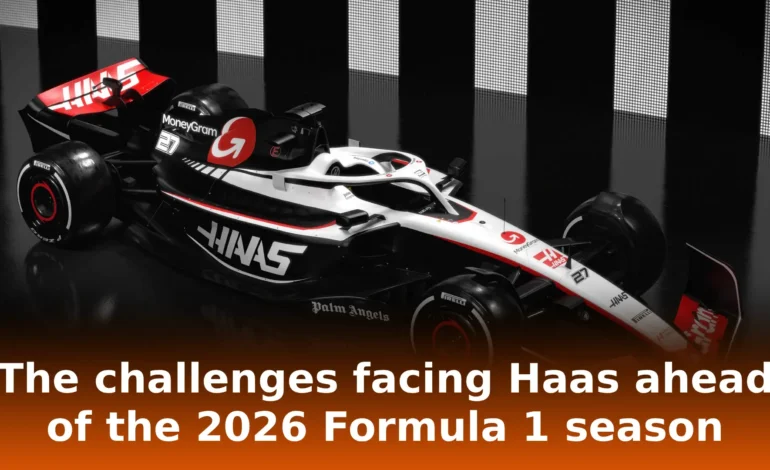

The 2026 Formula 1 car launch season is gathering momentum, and Haas is next in line to step into the spotlight. Following recent livery reveals from Red Bull Racing and Racing Bulls in Detroit, the American squad is preparing to unveil its new challenger on Monday via a streamlined online presentation.
While others opt for high-profile launch events, Haas continues to focus on substance over spectacle. As the sport approaches a major technical reset in 2026, the team faces a pivotal year that could shape its long-term future on the grid.
Table of Contents
ToggleWhat’s new at Haas for 2026?
One of the biggest developments is the deepening alliance with Toyota Gazoo Racing. What began as a technical partnership in 2024 has now evolved into a full branding integration, with the team officially entering the new era as the TGR Haas F1 Team.
A key benefit of this collaboration has been infrastructure. Haas has historically relied on Ferrari’s simulator in Maranello due to its power unit relationship with Ferrari, a less-than-ideal setup given Haas’ UK base in Oxfordshire. With Toyota’s support, the team has now developed its first dedicated driver-in-loop simulator at Banbury, a major step forward in performance development.
The partnership has also expanded Haas’ talent pool. Toyota endurance star Ryo Hirakawa joined as reserve driver, gaining F1 experience through multiple FP1 appearances. From a financial perspective, the deal allows Haas to offset certain component costs through sponsorship value rather than direct payments, an important efficiency gain for one of F1’s smallest teams.
This shift also marks the end of MoneyGram’s tenure as title sponsor, closing a chapter that began in 2023 and opening a new, more technically focused era for the squad.
The biggest challenge: scale and resources
Despite these positive steps, Haas still operates at a significant disadvantage compared to front-running teams such as McLaren, Ferrari, and Red Bull. Smaller facilities, a leaner workforce, and tighter budgets mean the American outfit must extract maximum value from every development decision.
This reality has been visible even on race weekends. Haas previously ran a three-person pitwall setup purely for cost reasons, compared to six or more at rival teams. Although that number increased in 2025, the underlying challenge remains: competing efficiently against organizations with vastly greater resources.
As a result, becoming a consistent race-winning team remains a long-term ambition rather than a short-term expectation.
Haas’ strongest asset: leadership
If there is one area where Haas has made decisive progress, it is leadership. Team principal Ayao Komatsu took over at the start of 2024 following the departure of Guenther Steiner, who had overseen the team since its 2016 debut.
Komatsu brought a calmer, more analytical approach, and the results were immediate. Haas climbed to seventh in the 2024 constructors’ standings and showed improved operational discipline. Rather than clashing with team owner Gene Haas, Komatsu focused on communication and maximizing existing resources, laying the groundwork for sustainable progress.
That stability carried into 2025 with a refreshed driver lineup featuring race winner Esteban Ocon and rising star Oliver Bearman. The pairing delivered Haas’ strongest points haul since 2018, highlighted by Bearman’s impressive fourth-place finish in Mexico.
What does success look like for Haas in 2026?
For Haas, success is measured differently than for the sport’s giants. In a season where midfield competition is tighter than ever, illustrated by Sauber securing a podium at Silverstone in 2025, the priority is consistent points finishes and continued operational growth.
The team finished 2025 eighth in the standings, but scored significantly more points than the previous year, underlining genuine progress. Replicating that trajectory in 2026, while fully integrating Toyota’s expanded role, would represent another important step forward.
As Formula 1 enters a new technical era, Haas may not yet have the tools to fight at the front, but with smarter partnerships, stronger leadership, and steady development, it is positioning itself to remain a competitive and credible force in the midfield.