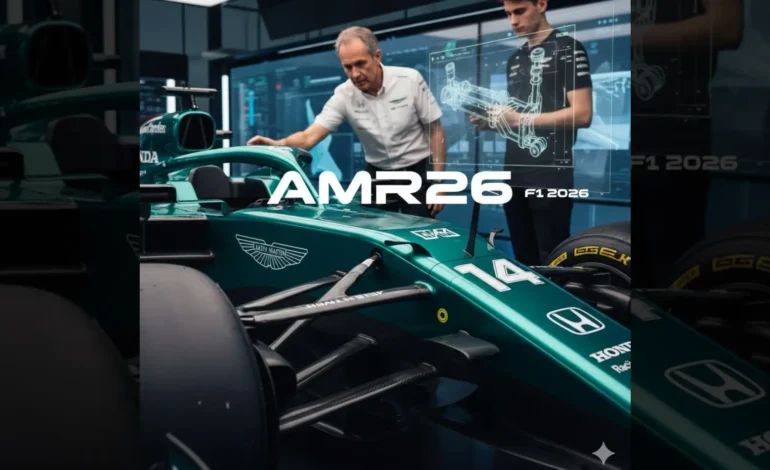
In the world of F1 design, Newey is legendary for his “24-hour rule”—a philosophy where ideas are critiqued and mured over for a full day before any carbon fiber is laid. For the Adrian Newey AMR26 suspension, this meticulous approach was pushed to the limit. Reports from Italian media suggest that Newey agonized over whether to follow the emerging trend of double-pushrod configurations or stick with a more bespoke solution tailored to the specific demands of the upcoming Honda power unit.
While rivals like Audi, Red Bull, and Ferrari are leaning toward pushrod setups at both ends to accommodate the move away from ground-effect-heavy floors, Newey’s focus remains on platform stability. His previous work on the Red Bull RB18 proved that superior suspension design can eliminate “porpoising,” a lesson Aston Martin is desperate to apply to their next-gen challenger.
The development of the Adrian Newey AMR26 suspension isn’t happening in a vacuum. It is the result of a powerhouse technical “brain trust” at Silverstone. The arrival of former Ferrari Technical Director Enrico Cardile as Chief Technical Officer adds a fascinating layer to the design process. Cardile previously defended Ferrari’s unique pullrod choices, whereas Newey has historically championed whatever the air tells him is fastest.
Furthermore, the integration with the new Honda power unit is proving complex. Koji Watanabe, President of HRC, recently admitted that while development is progressing, “not everything is going well.” This makes the mechanical grip provided by the suspension even more vital to compensate for any early-season power delivery fluctuations.
Challenges for the AMR26 Project
Despite the hype, Newey himself has been vocal about the steep hill Aston Martin must climb. He previously labeled the team’s simulation tools as “weak” and noted that the driver-in-the-loop simulator lacked the necessary correlation. To fix this, the team has recruited:
These hires aim to ensure that the Adrian Newey AMR26 suspension works perfectly in the virtual world before it hits the track for the first five-day test in Spain, scheduled for January 26-30.
Technical Synergy: Honda, Newey, and Enrico Cardile
The development of the Adrian Newey AMR26 suspension isn’t happening in a vacuum. It is the result of a powerhouse technical “brain trust” at Silverstone. The arrival of former Ferrari Technical Director Enrico Cardile as Chief Technical Officer adds a fascinating layer to the design process. Cardile previously defended Ferrari’s unique pullrod choices, whereas Newey has historically championed whatever the air tells him is fastest.
Furthermore, the integration with the new Honda power unit is proving complex. Koji Watanabe, President of HRC, recently admitted that while development is progressing, “not everything is going well.” This makes the mechanical grip provided by the suspension even more vital to compensate for any early-season power delivery fluctuations.
Challenges for the AMR26 Project
Despite the hype, Newey himself has been vocal about the steep hill Aston Martin must climb. He previously labeled the team’s simulation tools as “weak” and noted that the driver-in-the-loop simulator lacked the necessary correlation. To fix this, the team has recruited:
These hires aim to ensure that the Adrian Newey AMR26 suspension works perfectly in the virtual world before it hits the track for the first five-day test in Spain, scheduled for January 26-30.
F1 2026: A New Era of Active Aerodynamics
The 2026 season introduces active aerodynamics, where front and rear wings will adjust on the fly to reduce drag on straights and increase downforce in corners. In this environment, the Adrian Newey AMR26 suspension must act as the perfect anchor. If the suspension cannot maintain a stable ride height while the aero profile changes, the car will become unpredictable for drivers Fernando Alonso and Lance Stroll.
For more technical insights into the upcoming season, you can check out the official F1 Technical Regulations or read about Honda’s F1 history to understand their partnership goals.
Will the Late Decision Pay Off?
The late finalization of the Adrian Newey AMR26 suspension suggests that Aston Martin is looking for a “silver bullet” solution. By waiting until the last possible moment, Newey has been able to observe the trends of Audi and Red Bull while optimizing the AMR26 for the specific cooling and packaging needs of the Honda engine.
As the February 9 launch date approaches, the F1 world remains on edge. If Newey’s mechanical genius translates to the AMR26, Aston Martin could very well leapfrog the field. However, with “weak” simulation tools and a struggling engine partner, the pressure on this specific design choice has never been higher.